
Most golfers spend hours getting fitted for their driver and irons, then grab whatever 35-inch putter feels decent off the rack. That is a costly mistake. Putter length directly controls your eye position over the ball, your posture at address, and the path your stroke takes through impact. Get it wrong by even half an inch, and you are fighting your own geometry on every green.
This guide gives you a comprehensive putter length chart organized by height, explains why length matters so much, and walks you through exactly how to measure and fine-tune your fit. Whether you are building a custom putter from Phoenix Putter Co. or adjusting a putter you already own, the information here will put you in the right position to roll it pure.
Putter Length Chart by Height
Most golfers between 5'8" and 6'0" fit a putter between 33.5 and 34.5 inches — not the 35-inch off-the-rack standard. Use this putter size chart to find the recommended putter length for your height, then fine-tune with the wrist-to-floor adjustment table further down the page.
| Height | Recommended Putter Length | Notes |
|---|---|---|
| 5'0" – 5'2" | 31" – 32" | Rare stock length; custom build recommended |
| 5'2" – 5'4" | 32" – 32.5" | Women's standard range |
| 5'4" – 5'6" | 32.5" – 33" | Common for shorter male and average female golfers |
| 5'6" – 5'8" | 33" – 33.5" | Below-average male height; many benefit from 33" |
| 5'8" – 5'10" | 33.5" – 34" | Most popular fitting range |
| 5'10" – 6'0" | 34" – 34.5" | Standard men's stock length zone |
| 6'0" – 6'2" | 34.5" – 35" | Stock 35" works for many in this range |
| 6'2" – 6'4" | 35" – 35.5" | Often requires aftermarket or custom shaft |
| 6'4" – 6'6" | 35.5" – 36" | Extended length; custom fitting essential |
| 6'6"+ | 36" – 37" | Specialty build territory; counterbalancing may help |
Key takeaway: The old industry standard of 35 inches for men and 33 inches for women was never based on biomechanical research. It was based on manufacturing convenience. The average American male stands 5'9", which maps to a 33.5" to 34" putter, not 35". That means millions of golfers are using a putter that is a full inch too long.
Know your number?
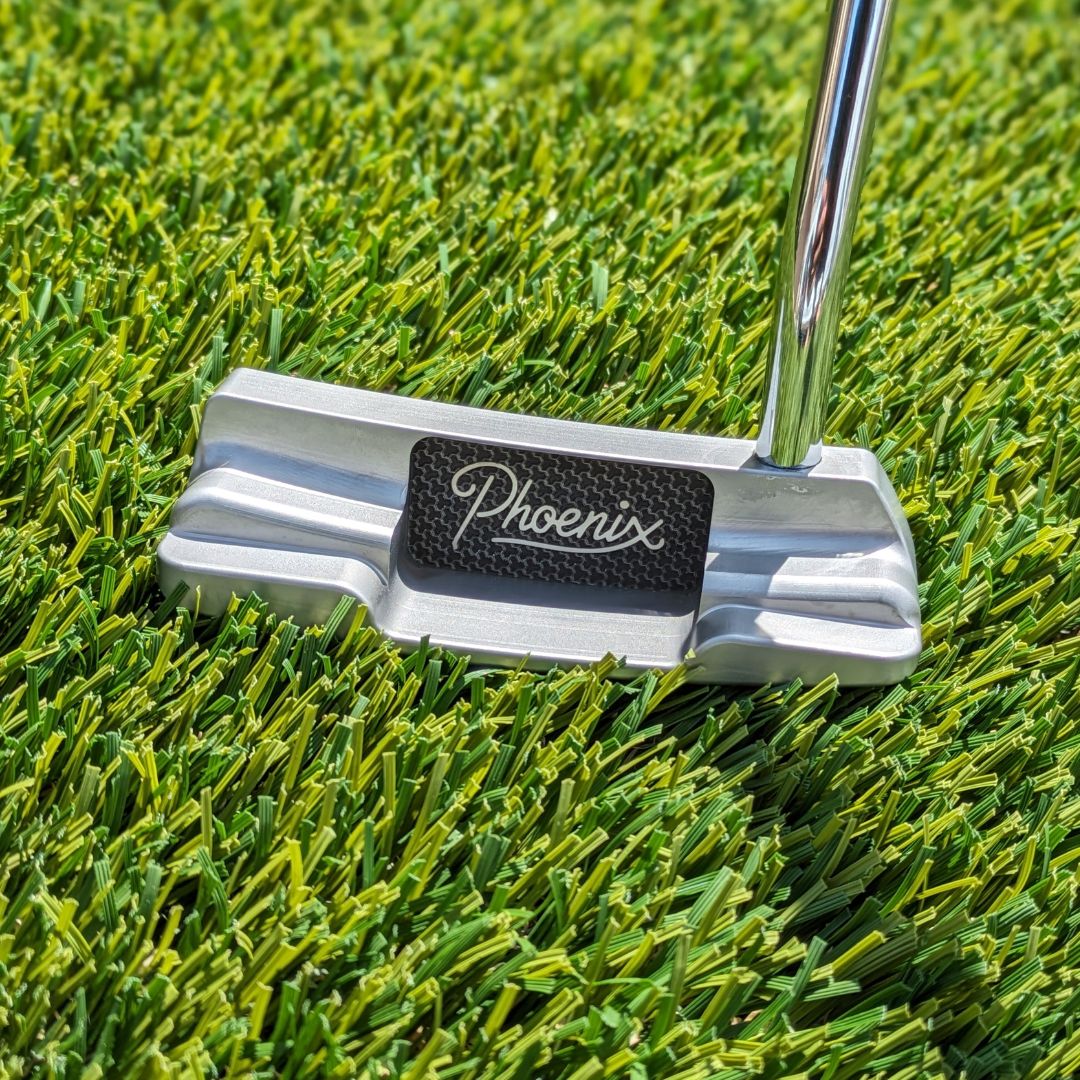
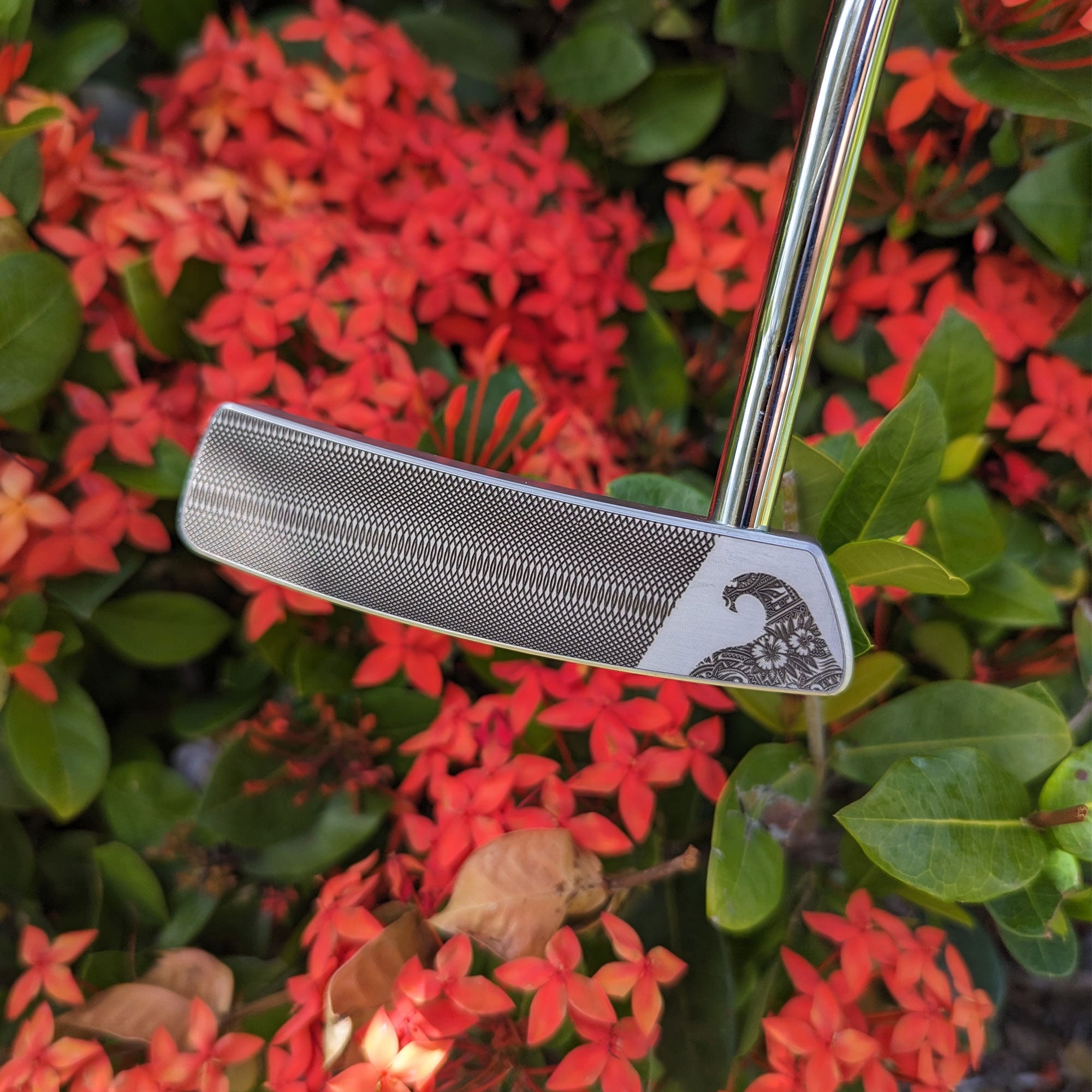
Every Phoenix putter is CNC-milled in the USA from 303 stainless and cut to your exact length — no choking down, no compromises. Free shipping and a lifetime warranty on every build.
Pick your head. Every one is cut to the length you choose:
What Determines the Correct Putter Length
Putter length is not a single-variable problem. Height is the starting point, but three additional factors refine the answer:
Arm length relative to height. Two golfers who both stand 5'10" can have a two-inch difference in wrist-to-floor measurement. The golfer with longer arms needs a shorter putter to avoid standing too upright, and the golfer with shorter arms needs more length to prevent excessive bending.
Posture preference. Some players prefer a more upright stance with their eyes just inside the ball line, similar to how Brandt Snedeker sets up. Others crouch lower with eyes directly over the ball, closer to the Tiger Woods school of putting posture. Your natural comfort zone shifts the ideal length by up to an inch in either direction.
Stroke type. A slight arc stroke typically pairs with a slightly longer putter because the golfer tends to stand a touch farther from the ball. A straight-back-straight-through stroke often benefits from a marginally shorter shaft, keeping the hands closer to the body and the eyes stacked over the target line. We cover this relationship in depth in our guide to putter head shapes, weights, and toe hang.
Grip style. A conventional reverse overlap grip positions the hands differently than a cross-handed or claw grip. The claw grip, for example, tends to push the lead hand slightly lower on the shaft, effectively shortening the playable length by about a quarter inch.
Why Putter Length Matters More Than You Think
Getting putter length right is not about vanity metrics. It controls three mechanical realities that determine whether you start the ball on your intended line.
Eye Position Over the Ball
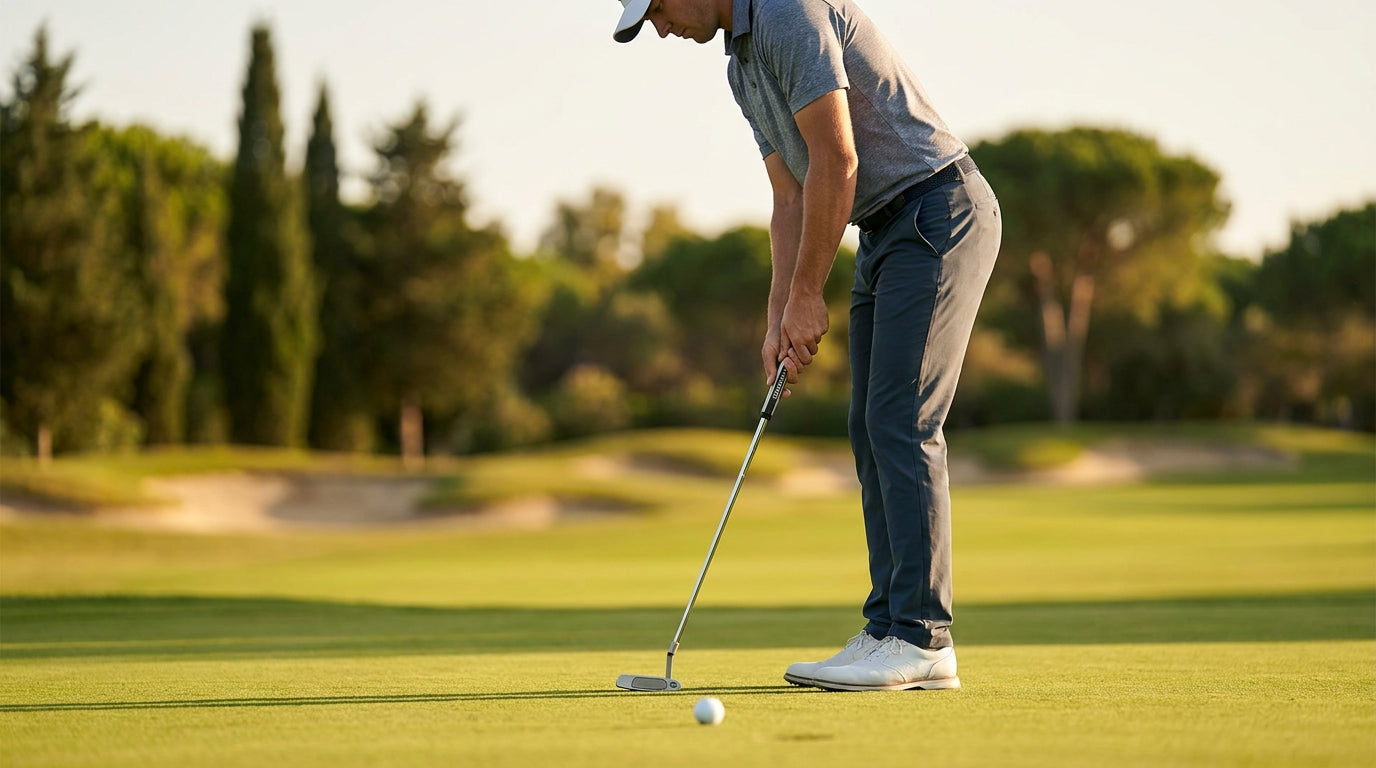
The single most important alignment factor in putting is where your eyes sit relative to the ball at address. The accepted standard, taught by putting coaches from Dave Stockton to Phil Kenyon, is eyes directly over the ball or up to two inches inside the ball line. A putter that is too long pushes your eyes well inside, making you aim right of target (for a right-handed golfer). Too short, and your eyes drift outside the ball, pulling your aim left.
Research from the SAM PuttLab database shows that golfers with properly fitted putter lengths average 1.2 degrees less aim error at address compared to those using a standard off-the-rack length. On a 15-foot putt, 1.2 degrees of aim error translates to missing the hole by roughly three inches, which is the difference between a make and a lip-out.
Posture and Tension
A putter that forces you into an unnatural posture creates tension in your forearms, shoulders, or lower back. Tension is the enemy of feel. When your muscles are working just to hold a position, they cannot provide the fine motor control you need for pace on a 40-foot lag putt or the precision you need inside the leather. Proper length lets your arms hang naturally from relaxed shoulders, with a slight bend at the elbows, roughly 15 to 20 degrees.
Stroke Path Consistency
Length influences how far you stand from the ball, which in turn affects your stroke arc. Stand too far away because the putter is too long, and the putter head swings on an exaggerated arc. Stand too close with a short putter, and you restrict the natural rotation, creating a jerky, handsy motion. Neither scenario produces repeatable results under pressure. For a deeper dive into how length interacts with your overall putting setup, see our definitive guide to putter length.
How to Measure Putter Length Correctly
There are two measurements that matter: the putter itself and your body.
Measuring Your Current Putter
The USGA defines putter length as the distance from the sole of the club (when the sole is resting flat on a surface at the designed lie angle) to the top of the grip, measured along the shaft axis. Here is how to do it at home:
- Set the putter on a flat, hard surface with the sole sitting naturally. Do not press the toe or heel down; let the designed lie angle dictate the position.
- Place a straight ruler or measuring tape along the back of the shaft from the ground contact point up to the top of the grip cap.
- Read the measurement in inches. Most stock putters measure between 33" and 35".
A common mistake is measuring with the putter in the playing position while gripping it. This introduces variability based on how much you press the shaft forward or back. Always measure with the sole flat on the ground.
Measuring Your Wrist-to-Floor Distance
This is the body measurement that refines the height chart above.
- Stand in your normal posture wearing flat-soled shoes (or no shoes, as long as you are consistent).
- Let your arms hang completely relaxed at your sides. Do not reach down.
- Have a partner measure from the crease of your wrist (where your hand meets your forearm on the pinky side) straight down to the floor.
- Record in inches.
The average wrist-to-floor distance for a 5'10" male is approximately 33.5 inches. If your measurement deviates from the average for your height, adjust accordingly using the table in the next section.
Arm Length vs. Height: The Adjustment Factor
Height gets you in the ballpark. Arm length gets you dialed in. Use this adjustment table after finding your baseline from the height chart above.
| Wrist-to-Floor Measurement | Adjustment to Baseline Length |
|---|---|
| More than 2" above average for your height | Subtract 0.5" to 1" |
| 1" to 2" above average | Subtract 0.25" to 0.5" |
| Within 1" of average | No adjustment needed |
| 1" to 2" below average | Add 0.25" to 0.5" |
| More than 2" below average | Add 0.5" to 1" |
Average wrist-to-floor measurements by height (for reference):
| Height | Average Wrist-to-Floor |
|---|---|
| 5'4" | 30.5" |
| 5'6" | 31.5" |
| 5'8" | 32.5" |
| 5'10" | 33.5" |
| 6'0" | 34.5" |
| 6'2" | 35.5" |
| 6'4" | 36.5" |
Example: A golfer who is 6'0" tall with a wrist-to-floor measurement of 36" is 1.5 inches above average for their height. Starting from the height-chart baseline of 34" to 34.5", they should subtract 0.25" to 0.5", landing on a fitted length of approximately 34 inches. Without this adjustment, they might have gone with 34.5" or even 35" and spent years fighting an eye position that was consistently inside the ball.
Fitting Adjustment Comparison Table
Beyond height and arm length, several other variables push the ideal length up or down. This table consolidates the most common adjustments a qualified fitter would consider.
| Factor | Adjustment Direction | Typical Range | Why It Matters |
|---|---|---|---|
| Long arms relative to height | Shorter putter | -0.25" to -1" | Prevents standing too upright with eyes inside |
| Short arms relative to height | Longer putter | +0.25" to +1" | Prevents excessive forward bend |
| Upright posture preference | Longer putter | +0.25" to +0.5" | Accommodates higher hand position |
| Crouched posture preference | Shorter putter | -0.25" to -0.5" | Keeps hands from crowding the body |
| Claw or pencil grip | Shorter putter | -0.25" | Lead hand sits lower on the grip |
| Arm-lock putting method | Longer putter | +2" to +4" | Shaft must reach mid-forearm |
| Counter-balanced setup | Longer putter | +0.5" to +1" | Extra weight in grip end allows longer shaft |
| Mallet head (higher MOI) | No change or -0.25" | Minimal | Heavier head can feel longer |
| Oversized grip installed | No change | Neutral | Grip diameter does not affect playing length |
When you build a custom putter with Phoenix Putter Co., every one of these variables is accounted for during the build process. The shaft is cut to your exact specification, and the lie angle is bent to match, so you never have to compromise.
Common Mistakes When Choosing Putter Length
Mistake 1: Using the "standard" length without questioning it. There is no universal standard. A 35-inch putter is only correct for roughly 15 percent of male golfers. The rest are adapting their posture to the club instead of fitting the club to their posture.
Mistake 2: Choking down instead of cutting down. Gripping an inch down on a 35-inch putter is not the same as playing a properly fitted 34-inch putter. When you choke down, the balance point shifts, the swing weight drops, and the grip taper no longer matches your hand position. The club feels lighter and less stable. If you find yourself consistently choking down, commit to getting the shaft trimmed or order the correct length from the start.
Mistake 3: Ignoring lie angle when changing length. Putter length and lie angle are linked. If you shorten a putter by an inch without flattening the lie angle, the toe will sit up at address, aiming you left. If you lengthen without adjusting lie, the heel lifts, aiming you right. Always address both variables together.
Mistake 4: Fitting on a putting mat instead of a real green. Indoor mats are perfectly flat and perfectly paced. They do not reveal the postural compensations you make on undulating greens with variable speeds. Get fitted on an actual putting green whenever possible.
Mistake 5: Neglecting grip size in the fitting equation. While grip diameter does not change playing length, it does change how your hands sit on the putter, which affects wrist action and perceived control. A thicker putter grip quiets the wrists and can make a slightly longer putter feel more manageable. Consider grip and length as a package, not separate decisions.
Frequently Asked Questions
What is the standard putter length for men?
Most off-the-rack men's putters ship at 34 or 35 inches. However, fitting data from major club manufacturers consistently shows that the most commonly fitted length for male golfers is 33.5 to 34 inches. The 35-inch "standard" is a holdover from decades past and does not reflect the biomechanical ideal for the average male golfer.
What is the average putter length?
The average putter sold off the rack measures 34 to 35 inches, but the average properly fitted length for male golfers is 33.5 to 34 inches, and 32.5 to 33 inches for female golfers. The gap exists because the average American male stands 5'9", which maps to a 33.5" to 34" putter on the fitting chart above — shorter than what most stock putters ship at.
How do I know if my putter is too long?
Three signs: your elbows are locked or nearly straight at address, your eyes sit more than two inches inside the ball when you look down, and you consistently miss putts to the right (for right-handed golfers) because your aim is off. You may also notice the heel of the putter lifting off the ground at address.
Can I just cut my putter shaft to make it shorter?
Yes, but with two caveats. First, cutting the shaft reduces swing weight by approximately three swing weight points per half inch removed. You may need to add head weight or use lead tape to restore feel. Second, you must re-evaluate the lie angle after cutting, because a shorter putter needs a flatter lie to keep the sole flush at address. A qualified fitter or club builder can handle both adjustments.
Does putter length affect distance control?
Absolutely. A putter that is too long forces you to stand farther from the ball, which lengthens your stroke arc and makes pace control less intuitive. Conversely, a putter that is too short can make your stroke feel cramped, leading to deceleration on longer putts. Proper length supports a natural pendulum motion, which is the foundation of consistent lag putting.
Should taller golfers use a belly putter or broomstick putter?
Not necessarily. Golfers up to 6'6" can be fitted with a conventional putter in the 36" to 37" range. Beyond that height, or for golfers with back issues that prevent a standard putting posture, an arm-lock setup (legal under the Rules of Golf as long as the shaft does not anchor against the body) at 38" to 41" may be worth exploring. A broomstick or chest putter, anchored during the stroke, is not permitted under current USGA and R&A rules.
How often should I get re-fitted for putter length?
Any time your posture changes significantly, whether from a swing change, an injury, aging, or a shift in your putting philosophy. Many golfers who switch from a conventional grip to a claw grip find they need a quarter-inch shorter putter. Similarly, golfers who develop lower back issues often benefit from adding a half inch to reduce forward bend.
Find Your Perfect Fit
A putter length chart gives you direction, but a custom-built putter gives you precision. At Phoenix Putter Co., every putter is built to your exact height, arm length, posture preference, and stroke type. No compromises, no choking down, no adapting your body to the club. Pair it with the right grip and a headcover that matches your style, and you have a setup that is genuinely yours.
Shopping for someone else? A custom putter cut to their exact measurements is the rare golf gift that gets used every round — see our guide to personalized golf gifts that actually get used, and add a set of custom golf ball markers to complete the package.
Browse the full collection of custom putters at Phoenix Putter Co. and start building the putter that fits your game.
Got your number? Build it to length.
Pick a head and choose your shaft length when you order. Every Phoenix putter is CNC-milled from 303 stainless and cut to that length before it ships.
 Origin
Milled blade · classic look and feedback★ 5.0 (18 reviews)$255
Build yours →
Origin
Milled blade · classic look and feedback★ 5.0 (18 reviews)$255
Build yours →
 Saguaro
Face-balanced mallet · for straight-back, straight-through strokes★ 5.0 (3 reviews)$299
Build yours →
Saguaro
Face-balanced mallet · for straight-back, straight-through strokes★ 5.0 (3 reviews)$299
Build yours →
 Hognose
Center-shaft mallet · zero toe hang, most forgiving★ 5.0 (1 review)$375
Build yours →
Hognose
Center-shaft mallet · zero toe hang, most forgiving★ 5.0 (1 review)$375
Build yours →
- Made to order, right or left handed
- Every putter ships free
- Ships 5–7 business days after proof approval
- Handcrafted in USA


Leave a comment
This site is protected by hCaptcha and the hCaptcha Privacy Policy and Terms of Service apply.