

Walk into any golf retailer and you will see putters described as "face balanced" or listed with a specific toe hang angle. Most golfers glance at that spec, shrug, and pick the one that looks best at address. That is a missed opportunity. Face balance is one of the most consequential design characteristics in a putter, and understanding it takes about five minutes. Those five minutes can fundamentally change how consistently you start the ball on line.
This guide explains exactly what face balance means, how to test any putter in seconds, why it matters for your specific stroke, and how to match the right balance profile to the way you actually putt. If you are considering a custom putter build, this is essential knowledge for making the right choices during the design process.
What Is Face Balance?
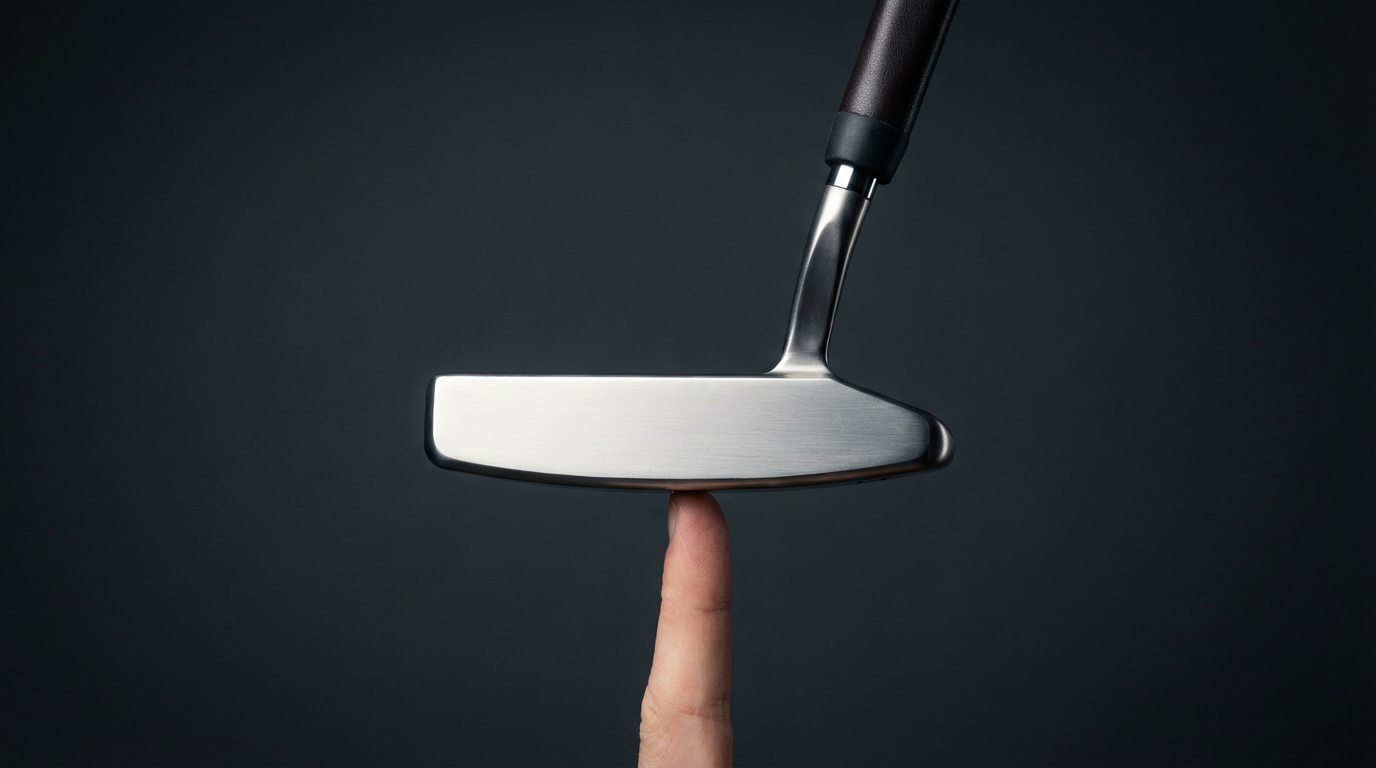
Face balance describes where the center of gravity sits relative to the shaft axis. When a putter is perfectly face balanced, the center of gravity is directly in line with the shaft, which means the face points straight up toward the sky when you balance the shaft on your finger.
In a toe hang design, the center of gravity is offset toward the toe of the putter, so when balanced on your finger, the toe drops and the face angles toward the ground at some degree. Common toe hang measurements range from 15 degrees (slight toe hang) to 45 degrees or more (strong toe hang, typical of classic Anser-style blades).
The physics are straightforward. During a putting stroke, the putter head wants to rotate around its center of gravity. A face balanced putter resists rotation because the mass is aligned with the shaft. A toe hang putter naturally wants to open on the backswing and close through impact because the offset mass creates a rotational tendency.
Neither design is inherently superior. The question is which one matches the stroke you already have, or the stroke your instructor is building.
The Balance Test: How to Check Any Putter in 10 Seconds
You do not need a fitting studio to determine whether a putter is face balanced. Here is the test:
- Hold the putter shaft loosely on your extended index finger (or balance it across your open palm) at the balance point, which is typically about 12 to 14 inches down from the grip.
- Let the head hang freely. Do not influence its position.
- Observe where the face points.
If the face points straight up at the ceiling: The putter is face balanced.
If the toe drops so the face angles toward the ground at roughly 15 to 25 degrees: The putter has moderate toe hang. This is common in mid-mallet designs and some plumber's neck blades.
If the toe drops significantly, angling the face 30 to 45 degrees or more toward the ground: The putter has strong toe hang. This is typical of classic blade putters with a simple heel-shafted or short hosel design.
The test takes seconds, and you can do it with any putter in your bag, at a store, or at a demo day. Once you know what you are holding, you can start making informed decisions. For a deeper exploration of how head shape and hosel design create these balance characteristics, see our breakdown of putter head shapes, weights, and toe hang.
Why Face Balance Matters for Your Stroke Type
Putting strokes fall on a spectrum from straight-back-straight-through (SBST) to a pronounced arc. Most golfers land somewhere between, with a slight arc being the most common pattern on Tour according to SAM PuttLab data.
Straight-Back-Straight-Through Strokes
If your putter moves on a relatively straight line during the stroke with minimal face rotation, a face balanced putter is your natural partner. Because the mass is centered on the shaft axis, the putter does not fight your hands by trying to open and close. It stays square with less effort, which means fewer compensations and fewer missed putts from face angle error.
Golfers who use an armlock method, a cross-handed grip, or a high-MOI mallet setup tend to gravitate toward SBST strokes. The face balanced design reinforces what they are already doing.
Slight Arc Strokes
The majority of Tour professionals, roughly 70 to 80 percent according to putting coach Marius Filmalter's published research, putt with a slight arc. The putter face opens a few degrees on the backswing, returns to square at impact, and closes a few degrees on the follow-through. For this stroke, a putter with moderate toe hang (15 to 25 degrees) often provides the best feedback and the most natural feel, because the toe hang encourages the rotation the stroke already produces.
That said, a number of slight-arc putters perform excellently with face balanced mallets. Jordan Spieth has used a face balanced Scotty Cameron for years despite having a slight arc. The distinction matters most at the margins. If your arc is barely perceptible, face balanced will work. If it is noticeable, moderate toe hang will likely feel more alive in your hands.
Strong Arc Strokes
Golfers with a pronounced arc, where the putter face opens 5 or more degrees on the backswing, need toe hang to match. A face balanced putter in the hands of a strong arc putter feels dead, like it is resisting every move. The golfer ends up manipulating the face to compensate, which destroys consistency. A blade with 30 to 45 degrees of toe hang flows with the arc and provides the rotational feedback these golfers depend on.
Face Balanced vs. Toe Hang: Complete Comparison Table
| Characteristic | Face Balanced | Moderate Toe Hang (15–25°) | Strong Toe Hang (30–45°) |
|---|---|---|---|
| Best stroke type | Straight-back-straight-through | Slight arc | Strong arc |
| Typical head shapes | Large mallet, high-MOI mallet | Mid-mallet, plumber's neck blade | Classic blade, heel-shafted |
| Face rotation tendency | Minimal; resists opening/closing | Moderate; follows slight arc | Significant; opens and closes naturally |
| Forgiveness (MOI) | Highest (4,500–6,000+ g/cm²) | Moderate (3,500–5,000 g/cm²) | Lowest (2,500–4,000 g/cm²) |
| Feel / feedback | Muted, stable | Balanced feel and feedback | Most responsive, most feel |
| Distance control | Excellent on flat putts | Excellent across conditions | Dependent on golfer skill |
| Alignment aids | Often includes lines or dots | Varies | Typically minimal |
| Common hosel types | Center shaft, wide flange | Short slant, plumber's neck | Heel shafted, flow neck |
| Grip pairing | Oversized grips common | Mid-size grips | Standard or slim grips |
| Ideal golfer | Wants maximum stability | Wants balance of feel and forgiveness | Prioritizes touch and workability |
Matching Putter Balance to Your Stroke: A Practical Process
Step 1: Identify Your Stroke Arc
The best way to determine your stroke arc is a SAM PuttLab session with a qualified fitter, which provides exact measurements of face rotation, path, and impact dynamics. If that is not accessible, here are two reliable at-home methods:
The gate drill. Set two tees just wider than your putter head about 12 inches behind the ball and 12 inches in front. Make your natural stroke. If the putter stays between the tees through the entire motion, you have a straight or near-straight path. If the putter exits the gate on the inside during the backswing and again on the follow-through, you have an arc.
The alignment stick method. Lay an alignment stick on the ground along your target line. Make your stroke and observe the putter head's relationship to the stick. A straight stroke tracks along the stick. An arc stroke moves inside the stick on the backswing, returns to the stick at impact, and moves inside again after impact. For a more detailed approach to alignment, check our guide on putting alignment.
Step 2: Match the Balance
Once you know your stroke:
- SBST or minimal arc: Start with face balanced. Test a center-shafted mallet and a wide-flange mallet to find a head shape you like at address.
- Slight arc: Try both face balanced and moderate toe hang options. Many golfers in this range find moderate toe hang more responsive, but face balanced works for those who prioritize stability.
- Strong arc: Go with toe hang. A classic blade or mid-mallet with a flow neck or short hosel will match your motion.
Step 3: Test on Real Greens
No amount of theory replaces rolling putts. Take your candidates to a practice green and hit 20 putts from 6 feet, 20 from 15 feet, and 10 from 30-plus feet. Pay attention to two things: how natural the stroke feels without conscious manipulation, and how consistent your start line is on the short putts. The putter that requires the least effort to keep the face square at impact is the right match.
What Tour Pros Use: Face Balance on the PGA Tour
The Tour landscape has shifted notably toward face balanced designs over the past decade, largely because modern mallet designs have proven that high MOI and face balance can coexist with premium feel.
Notable face balanced players:
- Jason Day has used a TaylorMade Spider, one of the most recognized face balanced mallets, throughout much of his career.
- Dustin Johnson switched to a face balanced TaylorMade Truss mallet and saw immediate improvements in strokes gained putting.
- Hideki Matsuyama games a Scotty Cameron mallet that is near face balanced, helping him maintain one of the steadiest strokes on Tour.
Notable toe hang players:
- Tiger Woods has used an Anser-style Scotty Cameron Newport 2 with roughly 30 degrees of toe hang for the majority of his career, matching his pronounced arc.
- Justin Thomas plays a Scotty Cameron blade with moderate toe hang, pairing it with a slight arc stroke.
- Collin Morikawa uses a blade-style putter with noticeable toe hang, consistent with his arc-driven technique.
The lesson from the Tour is not that one style dominates. It is that the best putters in the world match their equipment to their stroke. They do not force a stroke to match the equipment. That principle scales directly to every handicap level.
Common Mistakes with Face Balanced Putters
Mistake 1: Choosing face balanced because "it's more forgiving." High MOI is more forgiving on off-center hits, and many high-MOI putters happen to be face balanced. But face balance itself does not equal forgiveness. A face balanced blade with low MOI is not forgiving at all. Separate the concepts: MOI handles mishits, face balance handles stroke compatibility.
Mistake 2: Ignoring the shaft and hosel. A face balanced putter achieves its balance through the combination of head weight distribution and hosel/shaft position. Switching from a plumber's neck hosel to a center shaft on the same head can change the balance from moderate toe hang to face balanced. If you love a head shape but not the balance, ask about different hosel options. When you build with Phoenix Putter Co., the hosel configuration is part of the custom spec sheet.
Mistake 3: Fighting the putter's design. If you put a face balanced mallet in play and find yourself constantly manipulating the face to get it to rotate, you are fighting the design. That is your stroke telling you it needs toe hang. Listen to it. The putter should feel like it is working with you, not against you.
Mistake 4: Overlooking grip influence. A larger diameter putter grip quiets wrist action, which naturally makes your stroke straighter. This means a golfer who switches from a standard grip to an oversized grip might shift from a slight arc to a near-straight stroke, which could change the ideal balance profile. Always re-evaluate balance after a grip change. Our guide on putter grips and their impact on performance covers this relationship in detail.
Mistake 5: Assuming face balance only exists in mallets. While the majority of face balanced putters are mallets or mid-mallets, center-shafted blades can also achieve face balance. The Ping Anser 2 center shaft, for example, is nearly face balanced despite being a blade shape. If you prefer a blade look at address but want face balanced characteristics, a center-shaft configuration is worth exploring.
Frequently Asked Questions
How do I tell if my putter is face balanced without the balance test?
Check the manufacturer's specs. Most putter companies list toe hang angle or balance type on their website or in the product description. If the spec sheet says "face balanced" or lists a toe hang of 0 degrees, you have a face balanced putter. Anything above 10 degrees indicates some level of toe hang.
Can I make a toe hang putter face balanced?
Not practically. Face balance is a function of mass distribution relative to the shaft axis, which is determined by the head design and hosel position. You would need to either relocate the hosel (major modification) or add significant weight to the heel area, which changes feel and overall weight beyond reasonable limits. It is better to choose the right design from the start.
Is face balanced better for beginners?
Face balanced putters are generally more forgiving of stroke inconsistencies because they resist rotation. For a beginner who has not yet developed a consistent stroke arc, a face balanced mallet with high MOI provides the widest margin for error. As the golfer develops and their natural stroke arc becomes apparent, they can re-evaluate.
Do face balanced putters help with the yips?
Many golfers who struggle with the yips report improvement after switching to a face balanced, high-MOI mallet paired with an oversized grip. The combination reduces the influence of involuntary hand and wrist movements. It is not a guaranteed cure, but the stability of a face balanced design can help manage the symptoms.
What face balanced putter does Jordan Spieth use?
Jordan Spieth has used a Scotty Cameron Futura X5 and similar face balanced models from the Cameron line. Despite having a slight arc to his stroke, he prefers the stability of a face balanced design, which illustrates that personal preference and confidence matter alongside the technical matching guidelines.
Does face balance affect distance control?
Indirectly. A face balanced putter's resistance to rotation means the energy transfer at impact is more predictable on center strikes. This consistency can improve distance control over time because the golfer develops a more reliable feel for how far the ball rolls per unit of stroke length. However, the primary factor in distance control remains stroke tempo and green reading, not face balance alone.
Build the Right Putter for Your Stroke
Understanding face balance is one piece of the fitting puzzle, but it is a critical piece. The wrong balance profile forces compensations you may never even notice, quietly costing you strokes every round. The right balance lets your natural stroke express itself without interference.
At Phoenix Putter Co., every custom build starts with your stroke. We match head shape, hosel configuration, and balance profile to the way you actually putt, not to some generic standard. Add your preferred grip, protect it with a custom headcover, and mark your ball with a personalized ball marker. Every detail, dialed in.
Explore the full collection of custom putters at Phoenix Putter Co. and build a putter that matches your stroke from day one.

Leave a comment
This site is protected by hCaptcha and the hCaptcha Privacy Policy and Terms of Service apply.