

Golfers will spend hours researching head shapes, milling patterns, and grip options, then accept whatever shaft comes stock in their putter without a second thought. That is a mistake. The shaft is the only connection between your hands and the putter head. It determines how the club balances in your grip, how impact vibrations reach your fingers, how the head loads and releases through the stroke, and ultimately how much control you have over pace and direction.
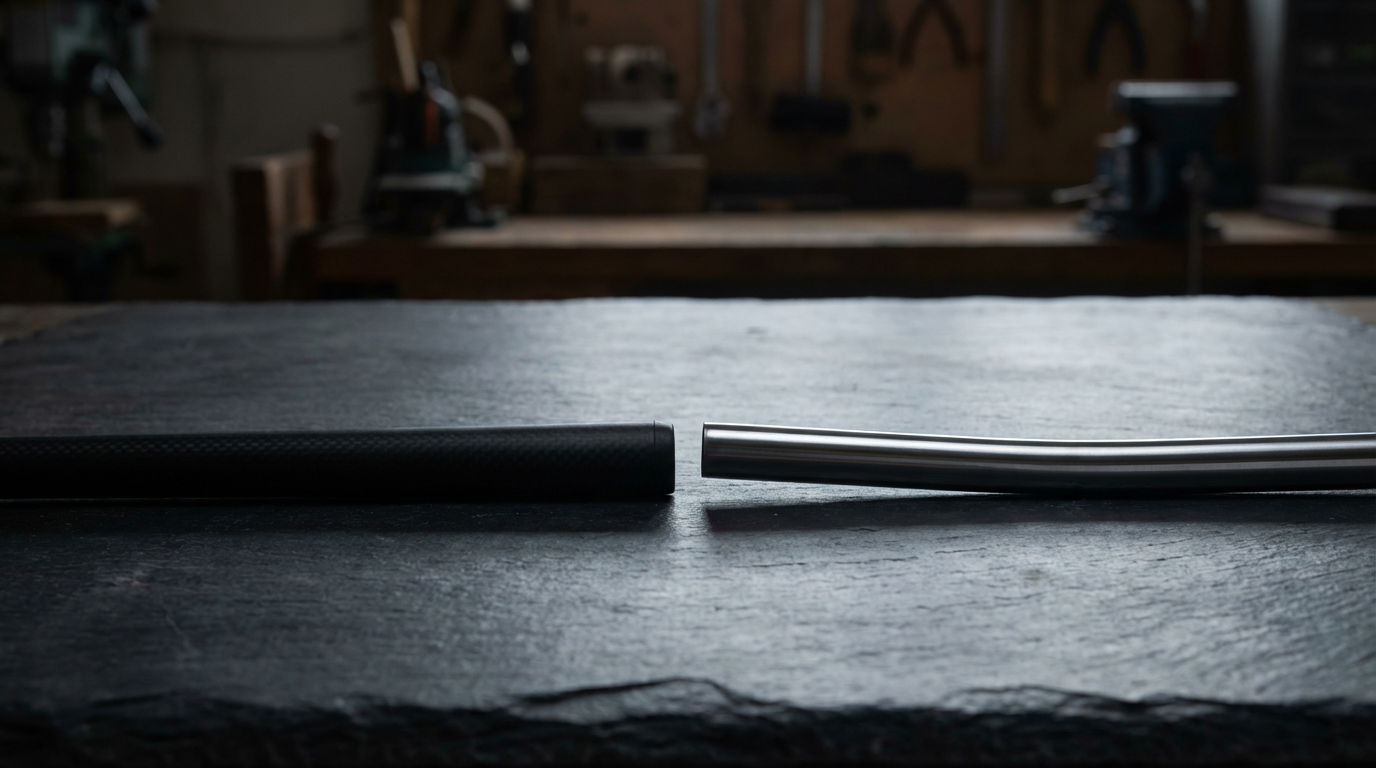
The shaft choice for putters comes down to two materials: graphite and steel. Each has distinct physical properties that affect performance in measurable ways. This is not marketing — it is material science applied to the most important club in your bag.
What Makes Putter Shafts Different from Iron Shafts?
Before comparing graphite and steel, it helps to understand why putter shafts are a separate category entirely.
Iron and driver shafts must manage enormous forces — swing speeds of 80 to 120 mph, impact loads exceeding 2,000 pounds of force, and the need to control both trajectory and spin. Putter shafts operate in a completely different environment: swing speeds of 4 to 8 mph, minimal impact force, and a premium on precision rather than power.
This means the criteria for a good putter shaft are different:
- Weight consistency matters more than weight savings. A putter shaft that varies by even 2 grams from the target weight changes the swingweight, which changes tempo.
- Vibration transmission matters more than stiffness. You are not trying to resist the twisting forces of a 105-mph swing. You are trying to feel whether you struck the sweet spot.
- Torsional stability at low speeds matters because even small rotational inconsistencies in the shaft can open or close the face by a fraction of a degree — enough to miss a four-footer.
Standard putter shafts weigh between 95 and 130 grams. Graphite putter shafts typically range from 50 to 80 grams. This difference sounds small, but when the total club weight is only 510 to 540 grams, a 50-gram swing in shaft weight represents a 10% shift in total mass — and a fundamental change in balance and feel.
For a deeper look at the case for lighter shafts, read our detailed guide on the benefits of graphite putting shafts over steel.
Why Shaft Choice Matters: Weight, Vibration, and Feel
Weight and Balance
Shaft weight directly controls where the balance point of the putter sits. A heavier steel shaft (120g) pulls the balance point higher — toward the grip end. A lighter graphite shaft (65g) drops the balance point lower — toward the head.
A lower balance point means more of the club's total mass is concentrated in the head. This produces a pendulum-like feel: the head wants to swing on its own, and your job is simply to guide it. Many golfers find this sensation promotes smoother tempo and reduces the tendency to manipulate the putter with their hands.
A higher balance point, conversely, gives the golfer more direct control over the head. The club feels more connected to the hands, and the stroke feels more "active." Some players — particularly those with aggressive, pop-stroke styles — prefer this sensation because it gives them precise control over acceleration through the ball.
Neither balance profile is inherently better. But understanding which one matches your stroke type is critical. If you have a long, flowing stroke (think Ben Crenshaw or Brad Faxon), a graphite shaft's lower balance point may complement your natural rhythm. If you have a short, firm stroke (think Tiger Woods circa 2000), a steel shaft's higher balance may suit you better.
Vibration Dampening
Graphite is a composite material — layers of carbon fiber bound by epoxy resin. This layered construction naturally absorbs and dissipates vibration. When you strike a putt with a graphite-shafted putter, the impact vibration is filtered before it reaches your hands. The sensation is smooth, almost silent in the hands.
Steel is a single-material construction with high vibration transmission. Impact energy travels through the shaft with minimal loss, delivering a sharper, more immediate tactile response. You feel the strike more acutely — the location, the quality, the energy transfer.
This difference has practical implications:
- Golfers with joint pain or arthritis overwhelmingly prefer graphite because of its vibration dampening. The reduced shock is easier on the hands and wrists across 30 to 40 putts per round.
- Golfers who putt by feel — adjusting their next putt based on the feedback from the last one — may prefer steel because it delivers richer information about each strike.
- Golfers on very fast greens (stimp readings above 11) sometimes prefer graphite because the dampened feedback reduces tension in the hands, promoting a softer grip pressure that is essential for pace control on slick surfaces.
Feel and Confidence
Feel is ultimately subjective, but it drives confidence, and confidence drives putting performance. A study published by Golf Laboratories Inc. found that golfers who described their putter as "feeling right" made 7 to 12 percent more putts from 6 to 10 feet in controlled testing — regardless of the putter's actual mechanical performance.
The shaft is a major contributor to that "rightness." If you have been putting with steel your entire career, switching to graphite can feel disorienting initially — the lack of feedback can register as a lack of control. Conversely, a golfer accustomed to graphite may find steel jarring and stiff.
The lesson: try both before committing. Your hands will tell you which feels right within a few strokes.
Graphite vs Steel Putter Shaft Comparison
| Property | Graphite Putter Shaft | Steel Putter Shaft |
|---|---|---|
| Weight Range | 50–80g | 95–130g |
| Balance Point Effect | Lower (more head-heavy feel) | Higher (more hand-connected feel) |
| Vibration Dampening | High — absorbs 40–60% of impact vibration | Low — transmits 80–90% of impact vibration |
| Torque (resistance to twisting) | 1.5–3.0° | 1.0–1.5° |
| Flex Profile | Slightly softer, progressive | Stiffer, uniform |
| Durability | 8–12 years (UV and impact sensitive) | 15+ years (corrosion is main risk) |
| Temperature Sensitivity | Minimal | Cold weather can feel harsh |
| Cost (shaft only) | $40–$120 | $15–$40 |
| Cost (installed in putter) | Adds $30–$80 to total | Usually stock (no upcharge) |
| Tour Usage (2025 season) | ~20–25% of PGA Tour players | ~75–80% of PGA Tour players |
| Best For | Smooth strokes, arthritis, fast greens, tempo-driven putters | Feel-first players, feedback seekers, pop strokes |
Steel or graphite — your call, your build
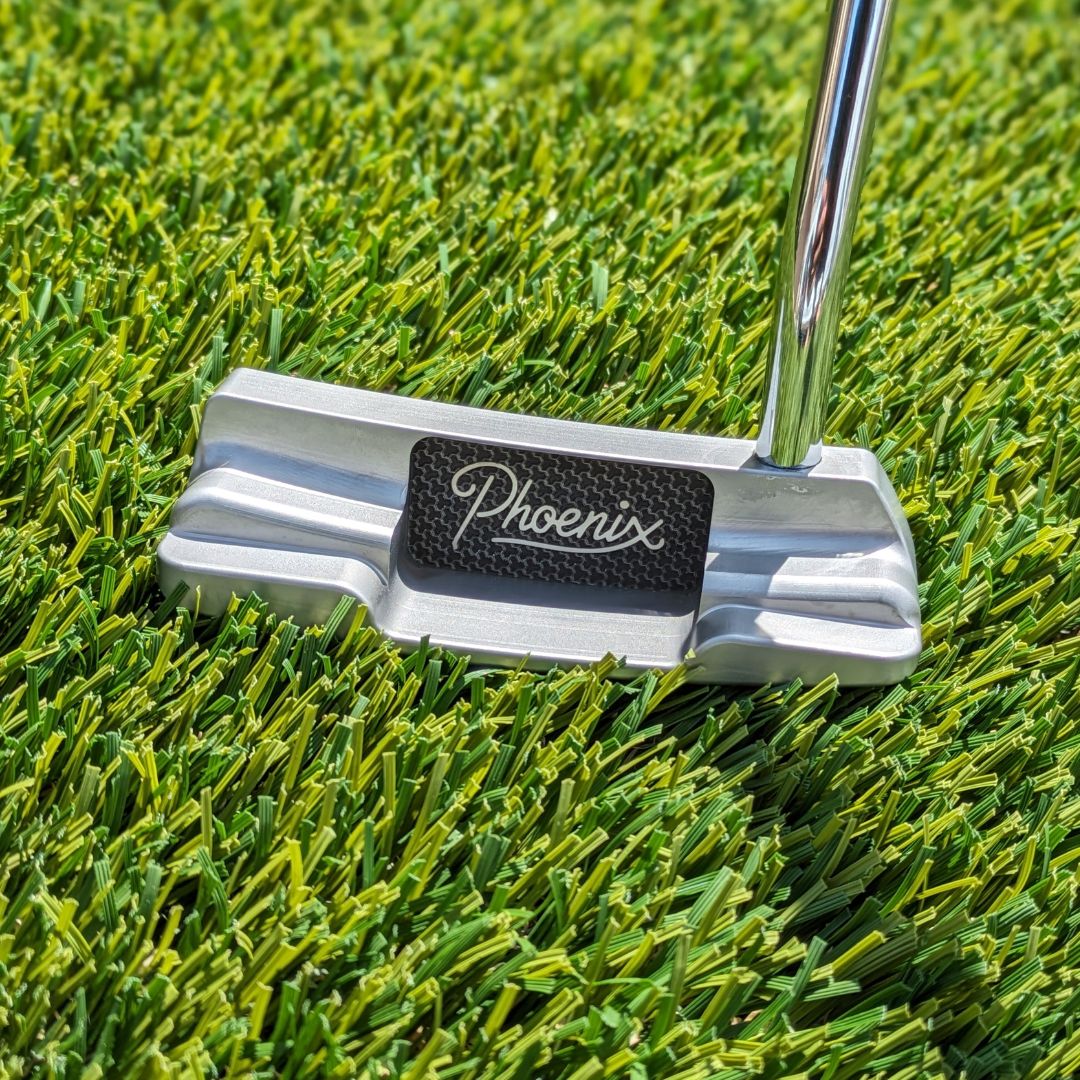
Every Phoenix putter is CNC-milled in the USA from 303 stainless and built with the shaft, length, and grip you choose — free shipping and a lifetime warranty on every build.
When to Choose a Graphite Putter Shaft
Graphite is not a gimmick or a trend. It solves specific problems and enhances specific stroke types. Choose graphite when:
You want to increase head feel without adding weight. Dropping 50 grams from the shaft and adding it to the head creates a higher swingweight — D5 to D8 range — without increasing total club weight. This is the principle behind counter-balanced putters and heavy-head designs, and graphite shafts make it easier to achieve.
You experience hand or wrist discomfort. Graphite's vibration dampening meaningfully reduces the micro-shocks transmitted with every putt. Over 36 holes in a tournament or a long practice session, this adds up. Multiple PGA Tour Champions (senior tour) players switched to graphite putter shafts specifically for joint comfort without sacrificing performance.
You play fast greens regularly. On greens stimping at 11 or above, the margin between a perfect lag putt and a three-putt is sometimes two inches of stroke length. Graphite's smooth feel promotes lighter grip pressure and more fluid tempo, both of which aid delicate pace control.
You have a long, arc-style stroke. Players with significant face rotation through the stroke — 3 to 5 degrees of open-to-close arc — often benefit from graphite's softer flex profile, which allows the head to load and release more naturally through the arc. This is particularly true with toe-hang putters that are designed to open and close.
You want a quieter sensory experience. Some golfers are distracted by the sharp click of steel-on-ball feedback. Graphite mutes the experience, allowing them to focus purely on visual feedback (watching the ball roll) rather than tactile feedback.
When to Choose a Steel Putter Shaft
Steel remains the standard for a reason. It is proven, affordable, and preferred by the majority of professionals. Choose steel when:
You rely on tactile feedback for distance control. The sharp, detailed vibration transmitted by a steel shaft tells your hands exactly how hard you hit the putt. Over time, this builds an unconscious library of feel-to-distance associations. If you calibrate your lag putts by feel rather than visual estimation, steel supports that process.
You have a short, firm stroke. Players who use minimal backstroke length and accelerate crisply through the ball — a "pop" stroke common among players who grew up on Bermuda greens — benefit from steel's direct, immediate connection between hand movement and head response. There is no lag, no flex absorption — what you do with your hands is exactly what the head does.
You prefer a lighter swingweight. Steel's heavier shaft weight pulls the balance point toward the grip, reducing swingweight without requiring lighter head weights. If you like a standard 340g head but want a swingweight around D2 to D3 (rather than the D5+ typical with graphite), steel gets you there naturally.
You want maximum durability. A steel putter shaft will outlast the rest of the putter. It is immune to UV degradation, impact cracking, and the gradual resin breakdown that can affect graphite over decades. If you buy a putter and keep it for 20 years, steel will still perform identically on day 7,300.
Budget is a factor. Steel shafts cost a fraction of graphite equivalents. If you are building a custom setup and need to allocate budget toward a premium head or fitting session, keeping the stock steel shaft is a pragmatic choice that sacrifices nothing for most golfers.
How Shaft Material Affects Your Stroke
The shaft's influence on stroke mechanics is subtle but measurable. Here is what high-speed camera analysis and shaft-mounted sensors reveal:
Tempo consistency: Graphite-shafted putters produce slightly more consistent tempo readings across a series of putts. The theory is that the lower balance point creates a more natural pendulum motion, reducing the golfer's tendency to "steer" the putter. A 2023 analysis by Quintic Ball Roll showed that golfers using graphite putter shafts had 8 to 15 percent lower tempo variability over 50-putt samples compared to steel.
Face angle at impact: Steel shafts, with their higher torsional rigidity (1.0 to 1.5 degrees of torque versus 1.5 to 3.0 degrees for graphite), deliver more consistent face angles at impact. For golfers who struggle with the face closing or opening at impact, steel's resistance to twisting provides a mechanical advantage.
Launch angle: Shaft flex can influence dynamic loft at impact. A graphite shaft with more flex may slightly increase dynamic loft (by 0.5 to 1.0 degrees), which can help the ball achieve true roll faster on slower greens. On faster greens, where lower launch is often desirable, a stiffer steel shaft maintains loft more precisely.
Stroke path: This is where shaft choice intersects with putter material and head design. A graphite shaft paired with a face-balanced mallet creates maximum stability and forgiveness — ideal for a straight-back-straight-through stroke. A steel shaft paired with a blade putter with moderate toe hang creates maximum feedback and control — ideal for an arced stroke. Matching shaft and head characteristics to your natural stroke is the key to optimization.
Common Mistakes When Choosing a Putter Shaft
Mistake 1: Assuming graphite is automatically better. Graphite putter shafts are a tool, not an upgrade. They solve specific problems — vibration sensitivity, desire for head-heavy feel, tempo inconsistency. If you are putting well with steel, there is no reason to switch purely because graphite is newer or more expensive.
Mistake 2: Ignoring swingweight changes. Swapping a 120g steel shaft for a 65g graphite shaft without adjusting head weight creates a putter that feels wildly different — often too head-heavy. A competent fitter will add or remove head weight to achieve the target swingweight after a shaft swap. Always account for the total system, not just one component.
Mistake 3: Judging feel from a single putt. Your first putt with a new shaft material will feel foreign regardless of whether it is right for you. Give it 50 to 100 putts before forming an opinion. Your hands need time to recalibrate to the new vibration profile and balance point.
Mistake 4: Choosing based on Tour trends without context. Yes, most Tour players use steel. But Tour players also practice putting for 60 to 90 minutes daily and have perfectly fitted equipment. Their shaft choice is optimized for their stroke, not yours. The 20 to 25 percent of Tour players who use graphite do so for specific, measurable reasons — not because it is trendy.
Mistake 5: Forgetting about grip interaction. The shaft and grip work as a system. A lightweight graphite shaft paired with a heavy counterbalance grip (80 to 100g) creates a very different feel than the same shaft with a standard 50g grip. When evaluating shaft material, keep the grip constant — or test both variables simultaneously with a fitter.
Frequently Asked Questions
Does putter shaft material really matter?
Yes. The shaft accounts for 15 to 25 percent of the putter's total weight and directly controls the balance point, vibration profile, and flex characteristics of the club. Changing from steel to graphite (or vice versa) produces a measurable difference in tempo consistency, grip pressure, and subjective feel. Whether that difference improves your putting depends on your stroke type and preferences.
What are the benefits of a graphite putter shaft?
The primary benefits are reduced weight (allowing more mass in the head), superior vibration dampening (easier on the hands and joints), and a lower balance point that promotes pendulum-like tempo. Graphite shafts are particularly beneficial for golfers with arthritis, those who play fast greens, and players with long, flowing strokes.
Is a graphite putter shaft worth the extra cost?
If you have a specific need — joint comfort, desire for a head-heavy feel, or tempo inconsistency — the $30 to $80 premium is easily justified by the performance benefit. If you are putting well with steel and have no physical discomfort, the upgrade may not produce noticeable improvement. A fitting session is the best way to determine if the investment makes sense for your game.
Do any PGA Tour players use graphite putter shafts?
Yes. Approximately 20 to 25 percent of PGA Tour players use graphite putter shafts as of the 2025 season. Usage is higher on the PGA Tour Champions, where vibration dampening and joint comfort are more valued. Notable graphite putter shaft users have included players seeking specific tempo and balance characteristics rather than following a broad trend.
How long does a graphite putter shaft last?
With normal use, a graphite putter shaft will last 8 to 12 years. The primary degradation factors are UV exposure (store your putter with a quality headcover) and impact damage (avoid leaning on the shaft). Unlike driver shafts, putter shafts are not subjected to high-stress impacts, so fatigue failure is extremely rare.
Can I retrofit my current putter with a graphite shaft?
In most cases, yes. A qualified club fitter can remove a steel shaft and install a graphite putter shaft, adjusting head weight if necessary to maintain the desired swingweight. The process takes about 24 hours for the epoxy to cure. Expect to pay $60 to $120 for the shaft and installation, depending on the specific shaft model.
What shaft do most custom putters come with?
Most custom milled putters ship with a steel shaft as standard, with graphite available as an option. When ordering a custom putter, you can specify your shaft preference and have the head weight adjusted accordingly — this is one of the advantages of a fully custom build versus buying off the rack.
Match Your Shaft to Your Stroke
The putter shaft is not an afterthought. It is the transmission system between your intent and the ball's behavior. Graphite and steel are both excellent materials with distinct performance characteristics, and the right choice depends on your stroke mechanics, physical needs, and sensory preferences.
If you value smooth tempo, joint comfort, and a head-heavy pendulum feel, graphite deserves serious consideration. If you value crisp feedback, direct control, and proven durability, steel remains the reliable standard.
Either way, the shaft should be chosen as part of a complete putting system — head material, milling pattern, grip, and shaft working together. Explore the custom putter collection at Phoenix Putter Co. and build a putter where every component is selected for your game, not pulled from a shelf.


Leave a comment
This site is protected by hCaptcha and the hCaptcha Privacy Policy and Terms of Service apply.